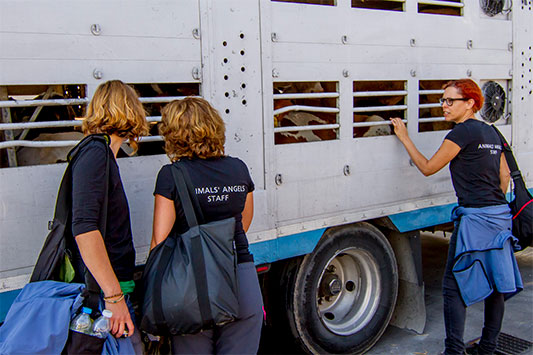
August 2026, southwestern Spain: During my second investigation in Spain, we are out on the road, waiting for transporters travelling carrying animals on short-distance journeys.
It is a cloudless summer day, and by midday the temperature has climbed well above 35°C. Even in the shade, we are already feeling uncomfortable, and I can hardly imagine what it must be like inside a transporter: no fans, crammed into a very confined space, surrounded by unfamiliar sights and constant noise, with no water available even when feeling desperately thirsty, and no chance to rest when they want to. They have to endure these conditions for several hours, with no idea of what lies ahead.
We come across a pig transporter, which we follow for more than two hours. Only when it leaves the motorway and stops briefly at a service station to refuel, do we have the opportunity to observe closely the animals inside. They belong to a pig breed typical of this region, the Cerdo Ibérico, which is bred for fattening. Every compartment is fully loaded. As we approach, we can feel the stagnant air escaping from the transporter and hear the animals making agitated noises. Their cries convey a mixture of confusion, fear, distress and utter exhaustion.
 |  |
My heart aches at this sight, and one question keeps coming back to me: What have they done to deserve THIS — a whole life spent serving human beings? Surely, it is our responsibility to provide them with the best possible life, one that meets their natural needs, when their entire existence is already determined by us from beginning to end? They never get the chance to escape this system; they are always at its mercy.
We have to hurry, as we have very little time to document as much as we can before the driver finishes refuelling.
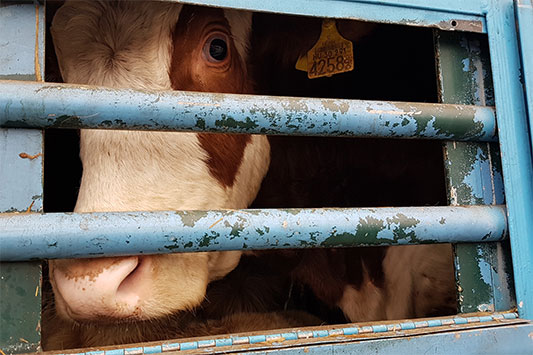
One of the pigs is pressed against the outer wall, right where I happen to be standing. I later name her “Jette” — inspired by a road sign with a similar place name that we keep passing on our evening drives. Jette looks deep into my eyes with an innocent and helpless gaze. The other pigs move restlessly back and forth, but she stands completely still for a while. Her eyes seem to suggest that she has almost given up. She looks tired, yet there is something about her gaze that makes me feel as though I can see into her trusting soul.
Her expression fills me with sadness, because I feel so helpless in this situation. I cannot save her, get her out of there or give her even just one day of a normal life, with the freedom to fulfil her natural needs as an animal. The only thing I can do is give her this moment of attention and write these lines dedicated to her. Create one brief, peaceful moment.
The driver climbs back in and starts the engine, so we step away from the truck. Jette keeps looking towards me, until the other pigs draw her attention away. The animals become increasingly agitated and restless once again.
We get back into our car and continue following the transporter to its final destination: the slaughterhouse. This is the moment when each of us goes our separate way — the pigs, still uncertain of what lies ahead, and me, hoping that they will not have to endure unnecessary suffering for much longer …
 |  |
I really hope that, as the animals continue on their journey, they can somehow sense that they are not alone — that we are thinking of them and carrying them in our hearts. They leave a mark on us, too, and we try to carry what they have touched within us out into the world, always hoping to help bring about change for the better.
Experiences like these often make me think: if everyone showed a little more awareness and empathy towards the world around them, we would already have taken a big step forward!