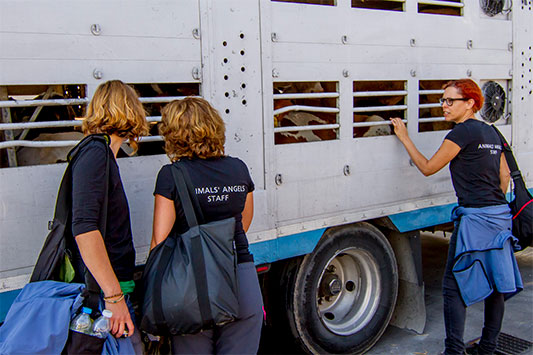
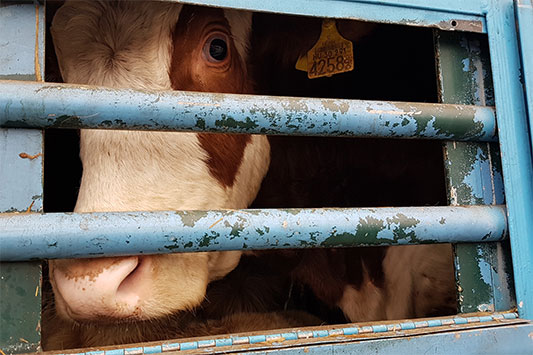
At the end of July, as part of our Animal Week, we monitored animal transports in Italy. Among others, we encountered two trucks transporting pigs to slaughterhouses.
It was hot, but not exceptionally so: the outdoor temperatures we measured were around 30 °C. Inside one of the trucks, we recorded as much as 34.2 °C. Temperatures that already put considerable strain on pigs: heat can become problematic for them from around 25 °C.
And this is exactly what we saw.
The pigs were panting, even while the trucks were moving, when the airflow created by the vehicle’s movement should at least have provided some relief. Some were breathing with their mouths open. Saliva and foam dripping onto the dirty floor of the vehicle. In the most serious case, their breathing was so laboured and noisy that it resembled an asthma attack. Some pigs had their tongues hanging out and were drooling heavily.
For the authorities, it is not enough to say that an animal “looks unwell”. Even when, in the face of such clear signs, it is obvious that the animal is suffering. During our monitoring activities, we therefore document every detail and also count breaths per minute, as scientists and veterinarians do when assessing an animal’s condition. This approach allows us to document the situation objectively. The data we collected confirm how severely the animals were suffering.
The trucks were equipped with fans and drinking devices, although these are not mandatory for journeys of less than eight hours. Some local veterinary authorities have explained to us that vehicles travelling short distances are equipped with such ventilation and watering systems to protect animals from heat during the summer. In one of the two cases, the driver had switched on the fans. They probably provided the animals with some relief: in that compartment, the ventilation was working and the stocking density was also appropriate. The animals’ condition did indeed appear less concerning than in the other transport – but it was still serious. However, the fans were not enough to alleviate the effects of the heat. In both cases, drinking devices were present but switched off. We saw some pigs trying to drink from the drinkers – but no water came out.
How frustrating and distressing must it be to be hot, search for water and be unable to drink?
The fact that the trucks are equipped with appropriate devices does not mean that the animals can actually benefit from them. Fans do not cool the air – they simply circulate it. And drinking devices alone do not guarantee that all animals can actually drink. In these cases, moreover, the drinking devices were not even switched on. In one of the two cases, the truck stopped to refuel while the pigs were still on board. In high temperatures, a stop means that the animals are exposed to the heat for even longer.
Arriving at the slaughterhouse does not mean that the ordeal is over
When one of the two trucks reached the slaughterhouse, we observed that the animals were still on board after at least 32 minutes. We do not know how long they actually had to wait before being unloaded. This waiting time means additional stress and suffering for the animals. They cannot leave the truck, seek out a cooler place or decide for themselves when to drink. They simply have to wait. And all this, to be slaughtered.
The transporter is not the only one responsible
The slaughterhouse should plan the arrival of animals in such a way that they can be received immediately, without unnecessary waiting, and without having to travel during the hottest hours of the day. Veterinary authorities, for their part, should carry out effective controls on so-called short-distance journeys, particularly during the summer, in order to prevent and counteract situations like these. Too often, short journeys are regarded as less problematic – as if the fact that animals spend less than eight hours on a truck automatically meant that their welfare was less at risk. Yet eight hours – or even just a few hours – in a truck in summer temperatures can be an enormous burden for animals.
We do not simply observe
We documented both cases and reported them to the competent veterinary authorities. But these two transports also highlight a more fundamental problem that we have been observing for years: animal transports must be planned in a way that genuinely takes summer temperatures into account. At the same time, greater attention and more effective controls are needed for national and short-distance journeys. We are still waiting for feedback from the authorities. We already raised this issue with the Italian Ministry of Health last year. We will now also bring our latest observations to the attention of the European Commission, the European Parliament and the Council, which are currently working on the revision of the Regulation on the protection of animals during transport. We want the new Regulation to address these problems effectively. The protection of animals during transport must not depend solely on the length of the journey, but on the conditions the animals are actually subjected to.
We hope that our reports will lead to concrete and encouraging responses – and, above all, to changes that will prevent such situations from happening again.