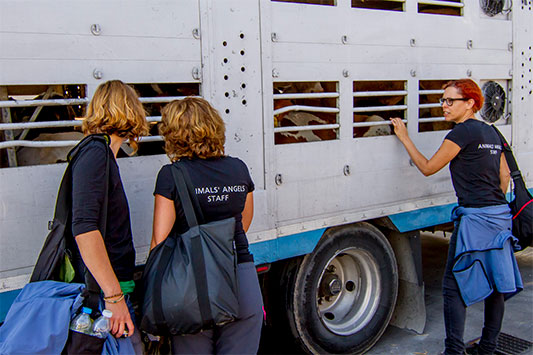
It is the evening, shortly after seven, when the truck stops in front of an Italian slaughterhouse. It is still around 30°C, and the air is humid and oppressive. For Elio, Pietro, and the other 114 pigs, the situation on board is unbearable. Elio and Pietro are lying lethargically on their sides, their legs stretched out and their heads flat on the floor. They are panting rapidly—Elio is counted breathing over 180 breaths per minute (by comparison, the normal rate for pigs is 10–20 breaths per minute, and anything above 40 breaths per minute is already considered elevated due to heat stress). All the pigs are breathing rapidly and suffering from heat stress.
Due to the cramped conditions on board, they are forced to lie tightly packed next to one another. Some are also sitting in a dog-like position, an indicator of possible additional health problems. Many are panting with open mouths—their only way of regulating body temperature to some extent, as pigs cannot sweat. We were already able to observe this during transport to the slaughterhouse, despite the airflow from driving and natural ventilation. Once the truck is stationary, air circulation inside the vehicle also stops, making conditions even more critical for the animals. It is irresponsible to transport animals during the day in such high summer temperatures. Even short journeys could be shifted to cooler nighttime hours, if they must take place at all.
Many of the pigs are dirty, and some are even covered in insect bites, which, according to the driver, they already had in the barn. This leaves us sadly imagining what their lives must have been like before.
When the truck enters the slaughterhouse premises, it parks there for more than an hour. Elio, Pietro, and the other pigs remain trapped inside the truck the entire time. Eventually, the truck starts moving again, but we cannot believe our eyes: it leaves the slaughterhouse grounds again with the pigs still on board—this is illegal for biosecurity reasons. We follow them once more, this time to a second slaughterhouse about 30 minutes away. Unfortunately, there is no longer any opportunity to observe Elio, Pietro, and the others up close. With heavy hearts, we document how they disappear into a slaughterhouse for the second time—this time for good.
In a meeting with the relevant Italian authorities, we have also informed them about this case. They will investigate it and hopefully take action to remind transporters that animals must not be transported during the hottest hours of the summer.