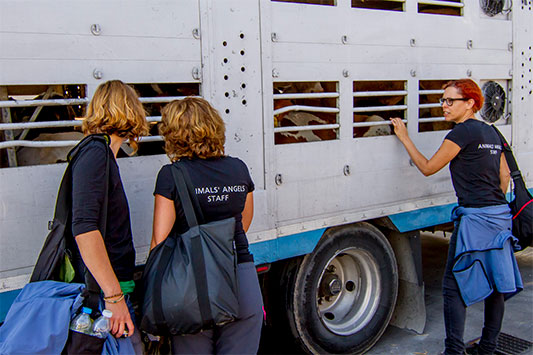
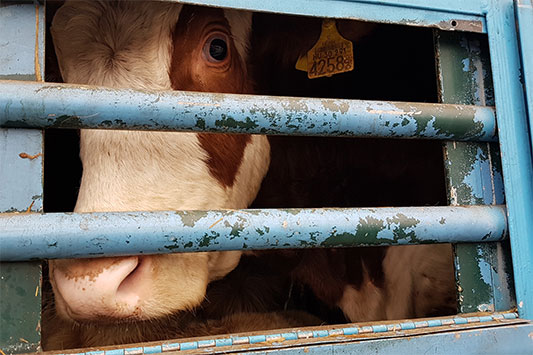
In September 2026, Animals’ Angels and the Animal Welfare Foundation monitor two transports of unweaned calves from Lithuania to Italy. Some of these calves are just two weeks old. They are transported across Europe to Italian farms, where they are to be raised for fattening and the production of white veal.
Despite their young age, the calves already have to endure a journey through several countries. When we encounter them, they moo almost constantly. They suck on one another’s ears, bellies and tails and lick the walls of the vehicle. Some try to suck from the drinkers, but the water supply is switched off. Others have foam around their mouths.
These are not isolated behaviours. Taken together, they suggest that the animals are suffering from hunger and stress.
Both vehicles are equipped with metal nipple drinkers, which are generally designed for pigs and fitted with rubber teats. These drinkers are not comparable to the bottles used to feed milk to calves, and the animals are not accustomed to drinking from them. More importantly, water cannot replace milk. Calves this young still depend on milk or milk replacer to meet their nutritional needs.
According to the transport documents, the calves last received milk or milk replacer at a farm in Poland, where they had stopped for 24 hours. This farm is approximately 1,487 km away. By the time we encounter the calves, more than 20 hours have already passed since that stop.
Very young calves need milk regularly. Under normal rearing conditions, they are generally fed milk or milk replacer at least every 12 hours. Calves suckling from their mothers may feed much more frequently. Their need for milk does not simply disappear because they are being transported.
In both cases, we contact the Austrian and Italian police. In Italy, motorway police intervene together with on-call veterinarians from the local health authorities. Although we observe similar problems on both transports, the outcomes differ. In one case, the transporter is fined because some drinkers are out of reach and unsuitable for the calves. In the other, no irregularities are found, despite our concerns about the animals’ access to milk and water. This inconsistency highlights the importance of clear guidelines to ensure that the needs of unweaned calves are properly understood and assessed during transport.
Animals’ Angels has asked the Italian Ministry to provide official veterinarians responsible for transport inspections with clear guidance on feeding and watering these very young animals. The Ministry has informed us that it is working on the issue. We have also started a dialogue with the veterinary offices responsible for transport checks in Italy and are preparing reports for the competent authorities in Poland and Lithuania.
Yet even better inspections cannot change one fundamental fact: these calves are still babies and still depend on milk.
Animals’ Angels will continue to urge the decision-makers working on the revision of EU animal transport legislation to ensure that calves who still depend on milk are not subjected to long, exhausting journeys that cause them suffering.
These calves cannot tell us in words what they need. But their desperate attempts to suck our hands, their incessant calls and their frantic search for something to suck made it clear that something was wrong. Their needs are not an inconvenience to be managed along the way. They deserve to have those needs met.
The question is not simply how to transport unweaned calves. The question is whether animals of this age should be subjected to such long journeys at all.